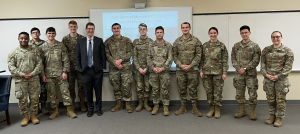
 Center director, Avinoam Patt, had the honor of lecturing to a class of cadets at US Military Academy West Point at an annual lecture sponsor by the Center for Holocaust and Genocide Studies there on March 29, 2023.
Author: Joscha Jelitzki
Cohen Match Challenge

Robert Cohen ’67 (CLAS) and Barbara Cohen ’67 (CLAS) have launched a matching gift challenge in support of the Fund for the Enhancement of Judaic Studies, which supports programming in our Center. Any gifts made to this fund between now and December 31, 2023, will be matched by the Cohens, up to $25,000. This gift is the latest in the Cohens’ legacy of support for UConn’s Center for Judaic Studies and Contemporary Jewish Life. The Cohen and Henes Scholarship Fund for Judaic Studies benefits undergraduate and graduate students who pursue a course of study in Judaic Studies. Beyond supporting scholarships, the Cohens also established the Fund for the Enhancement of Judaic Studies, thereby creating another means for anyone interested in supporting Judaic Studies at UConn—at any level of giving—to follow their generous example and support this important work.
Welcome, Professor Yonatan “Yoni” Miller!
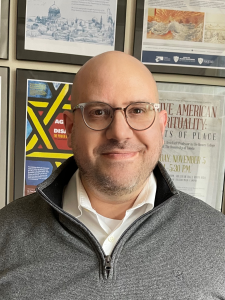
Yonatan “Yoni” Miller joins us from the University of Toledo in Northwest Ohio, where he was most recently the Philip Markowicz Endowed Assistant Professor of Judaism and Jewish Biblical Studies and the director of the Center for Religious Understanding.
Originally from Teaneck, New Jersey, Yoni earned his BA from Yeshiva University, summa cum laude, in Judaic Studies. He spent two years as a visiting graduate student at the Hebrew University in Jerusalem, and went on to complete both an MA and PhD in Ancient Judaism at Harvard University under the tutelage of Professor Shaye J.D. Cohen. After the completion of his PhD, he held a Harry Starr fellowship at Harvard’s Center for Jewish Studies.
Yoni’s research and teaching interests span from the Hebrew Bible through the Cairo Geniza. He is interested broadly in the first millennium of Jewish biblical interpretation, with specific interests in post-destruction literature on the Israelite priesthood as well as the history of the modern study of ancient Judaism.
Recently his translation of Mishnah Yoma was published in the Oxford Annotated Mishnah and he has an article forthcoming in the Harvard Theological Review. He is currently working on a monograph entitled Rewriting Priestly Authority in Late Antiquity. Along with Yale Divinity School’s Jacqueline Vayntrub, he is also co-editing a book entitled The Motif in Biblical Literature: Contours, Critiques, and New Horizons, which will be published with T&T Clark (Bloomsbury).
Yoni is excited to return to his family roots in the Hartford area, the birthplace of his late grandmother Ruth, and the home of his great-great grandparents and great-grandparents in the late 19th and early 20th centuries.
Yoni is joined by his wife Rebecca Keys, their two children, Tair and Yadin, and their two pugs, Kishke and Farfel-Kugel.
Yoni Miller will be joining the Hebrew and Judaic Studies Faculty as Assistant Professor Hebrew and Judaic Studies beginning in Fall 2023.
Stuart Miller, “Face of HEJS at UConn,” Retires After 40 Years
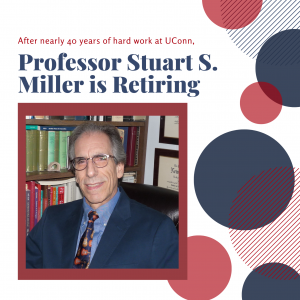 Dr. Stuart Miller, “the face of Hebrew and Judaic Studies at UConn,” retires after 40 years
In his 40 years as professor of Hebrew, History and Judaic Studies at the University of Connecticut, Dr. Stuart Miller has shared his knowledge of rabbinic Judaism and Greco-Roman Palestine with thousands of students and mentored numerous graduate students. He served as academic director of the UConn Center for Judaic Studies and Contemporary Life, helping to build the program that exists today.
Read the Southern New England Jewish Ledger article about Professor Miller's retirement.
Daniel Hershenzon’s “Captive Sea” translated into Hebrew
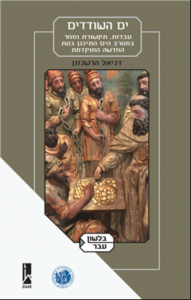 The Captive Sea - Slavery, Communication, and Commerce in Early Modern Spain and the Mediterranean (2018) by UConn Associate Professor, Daniel Hershenzon, was recently published in Hebrew translation by the Hebrew University Magnes Press.
Learn more and get your copy [here]
Susan Einbinder’s Newest Book is Now Published
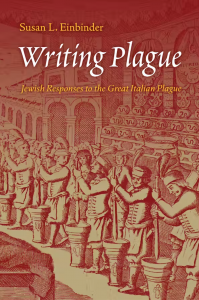
Congratulations to our faculty member, Susan Einbinder, who has her newest book, Writing Plague - Jewish Responses to the Great Italian Plague out, published University of Pennsylvania Press.
Learn more and order your copy here: https://www.pennpress.org/9781512822878/writing-plague/
Stuart Miller Elected to American Academy of Jewish Research
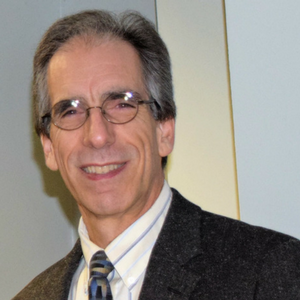
Professor Miller was recently elected to the AAJR (American Academy of Jewish Research). Stuart's scholarship is widely recognized for its path-breaking contributions to the study of Greco-Roman Palestine and Rabbinic Judaism. During his four decades of service, he has been a devoted teacher to literally thousands of UConn students. Stuart was interviewed on the UConn 360 podcast this month, as he reflected on his years in Storrs and beyond. You can listen to the podcast here.In Spring 2023, we will host a scholarly symposium at UConn to celebrate Stuart’s many accomplishments with former colleagues and students.
His book publications include Studies in the History and Traditions of Sepphoris (E. J. Brill, 1984), Sages and Commoners in Late Antique ’Erez Israel: A Philological Inquiry into Local Traditions in Talmud Yerushalmi (Mohr-Siebeck, 2006), and At the Intersection of Texts and Material Finds: Stepped Pools, Stone Vessels, and Ritual Purity among the Jews of Roman Galilee, which appeared in 2015 in the Journal of Ancient Judaism Supplement Series (Vandenhoeck & Ruprecht).
For more please visit: http://aajr.org/aajr-
Susan Einbinder Elected to American Academy of Jewish Research
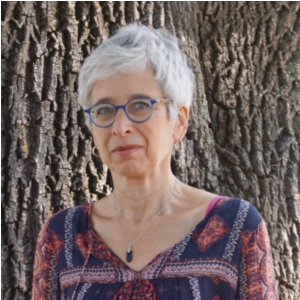 Professor Susan Einbinder was recently elected to the AAJR (American Academy of Jewish Research). Susan's scholarship on medieval Jewish and European history and culture is widely recognized for its path-breaking contributions to the study of Jewish-Christian and Jewish-Muslim relations in the medieval period. Over the last two years, her scholarship on the Black Death and religious responses to pandemic and plague has attracted global interest and attention. Susan's newest book, Writing Plague: Jewish Responses to the Great Italian Plague, will be published by the University of Pennsylvania Press later this year. She has been the recipient of many prestigious awards and fellowships, including a Guggenheim, a fellowship from the Center for Advanced Studies at Princeton, and the National Humanities Center.
For more please visit: http://aajr.org/aajr-
October 2021 E-Newsletter released